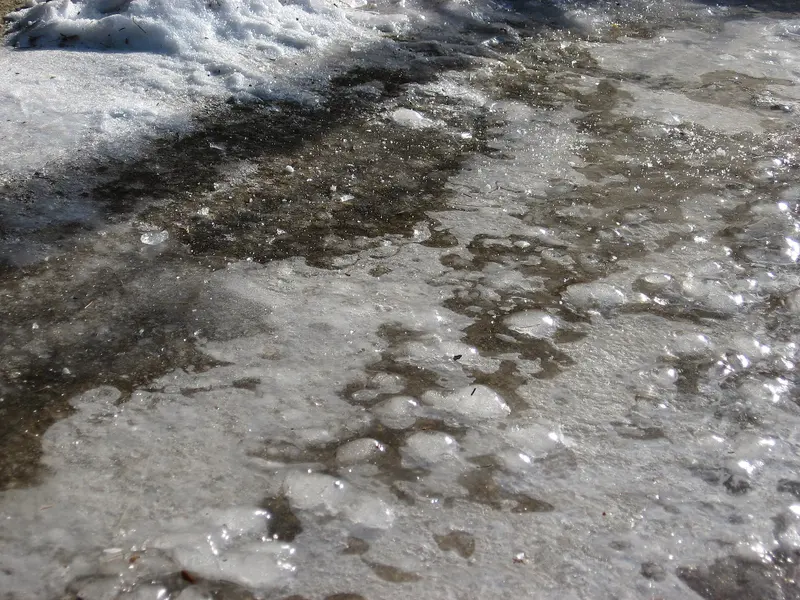
Winter changes the risks in almost every workplace: icy car parks and entrances, colder buildings, outdoor work in the dark. HSE publishes practical advice on all of these. This article summarises it, then looks at how an occupational health and safety management system built to ISO 45001 deals with seasonal risks — and the revision of the standard now in progress.
This is general information. HSE's guidance is the authority for your duties.
Ice, frost and snow
HSE's slips and trips FAQs give practical points on bad weather:
- Grit before it's needed. HSE says gritting "should be carried out when frost, ice or snow is forecast". The best times, it says, are early in the evening before the frost settles and/or early in the morning before employees arrive.
- Salt needs time. In HSE's words, "Salt doesn't work instantly" — it has to dissolve into the moisture on the surface.
- Watch for dawn frost on surfaces that looked dry.
- Compacted snow that turns to ice is difficult to treat effectively with grit, so clear snow before it is packed down.
- Know your trouble spots: building entrances, car parks, walkways, shortcuts, slopes, and areas that are shaded or often wet.
HSE's slips and trips pages also cover causes and prevention, the roles of employers, workers and designers, and case studies.
Cold indoors and out
HSE's guidance for employers on workplace temperature says the minimum indoor temperature should normally be at least 16°C, or 13°C where much of the work involves rigorous physical effort. Employers should take practical steps to keep workers as comfortable as possible in the cold, and protect people doing long periods of outdoor work in cold conditions. HSE encourages workers to talk to their employer if the temperature isn't comfortable.
How ISO 45001 handles seasonal risks
iso.org describes ISO 45001 as specifying requirements for an OH&S management system, with key elements including leadership commitment, worker participation, hazard identification and risk assessment, legal and regulatory compliance, emergency planning, incident investigation and continual improvement — using Plan-Do-Check-Act.
Seasonal risks fit naturally into that cycle:
- Plan — hazard identification should cover foreseeable changes such as winter weather and darker hours, not just the normal working day.
- Do — operational controls: a gritting plan and who does it, heating, rotas for outdoor work, emergency arrangements for snow days.
- Check — monitoring and internal audit: were the checks done, and were near misses reported?
- Act — incident investigation and improvement before next winter.
Worker participation is one of the key elements iso.org lists: the people who use the car park at 7am usually know where the ice forms.
ISO 45001 is being revised
The current edition is ISO 45001:2018. iso.org now marks it "to be revised" (stage 90.92), lists a new version under development at draft international standard (DIS) stage, and says it is expected to be replaced within the coming months. Courses based on the 2018 edition remain useful — most of the content carries over — but if you're booking for 2027, ask the provider which edition it teaches and whether a transition course will follow. Our ISO 45001 page will be updated when the new edition is published.
A winter check for internal auditors
If you audit your own organisation's system, a short seasonal check is a good exercise:
- Does the risk assessment mention winter weather, darkness and cold at all?
- Is there a named person and a written plan for gritting, and is it being followed?
- Were the heating and outdoor-work arrangements discussed with workers?
- Are slips and near misses on ice reported and investigated?
Evidence beats assurances: records, rotas and photographs of the gritting store all count.
Training for ISO 45001
- ISO 45001 Foundation / requirements 4 UK courses
- ISO 45001 Internal auditor 5 UK courses
- ISO 45001 Lead auditor 6 UK courses
- ISO 45001 Implementer / lead implementer 4 UK courses
- ISO 45001 Auditor conversion 4 UK courses
UK internal auditor courses currently listed:
| Course (as named by the provider) | Provider | Certified by | Duration | Link |
|---|---|---|---|---|
| Internal Auditor Training Course - ISO 45001Classroom; Live online; In-house | BSI | Not stated | 2 days | Course pagechecked 3 October 2026 |
| CQI and IRCA ISO 45001 Internal Auditor Training (A2199)Virtual – tutor led | NQA | CQI and IRCA certified | 2 days | Course pagechecked 3 October 2026 |
| ISO 45001 Internal Auditor Training Course | Bywater | Not stated | 2 days | Course pagechecked 3 October 2026 |
| ISO 45001 Internal Auditor Training Course – OnlineOnline | Amtivo (British Assessment Bureau) | Not stated | 2 days | Course pagechecked 3 October 2026 |
| IMSM ISO 45001 Internal Auditor Training (live online)Live online | IMSM | CPD certificate | See provider | Course pagechecked 3 October 2026 |
For the audit side, our guide to writing audit findings helps with one of the parts of an auditor course people find hardest.