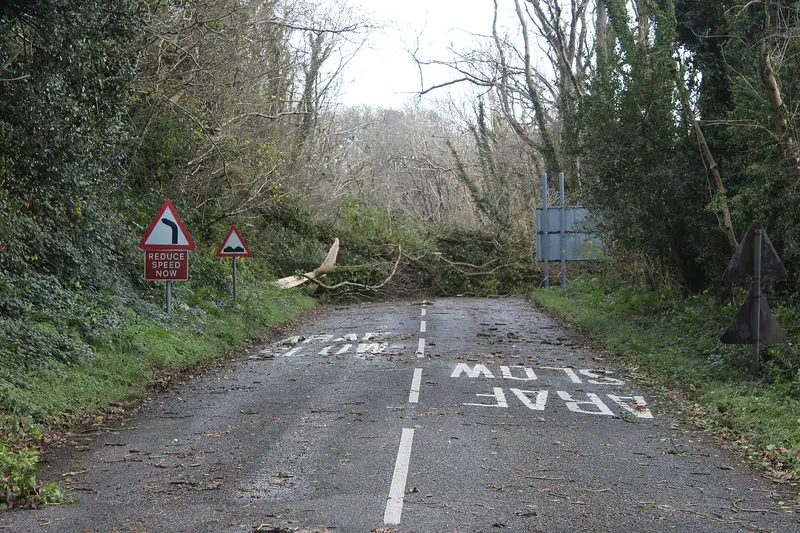
Every winter brings the same tests for an organisation's resilience: a named storm that closes roads, snow that keeps staff at home, a power cut that takes down the office or a supplier's warehouse. Our post on HSE's winter advice and ISO 45001 covers keeping people safe. This one is about keeping the work going — the territory of business continuity and ISO 22301.
Start with the warnings
The Met Office issues weather warnings through the National Severe Weather Warning Service up to seven days ahead, for rain, thunderstorms, wind, snow, lightning, ice, extreme heat and fog. Each warning is yellow, amber or red, depending on how severe the impacts could be and how likely they are:
- Yellow — many warnings are issued when there is a high likelihood of some moderate impacts; others signal bigger impacts that are less certain, so the Met Office says to read the text.
- Amber — "an increased likelihood of impacts from severe weather, which could potentially disrupt your plans", such as travel delays, closures and power cuts.
- Red — "Dangerous weather is expected and, if you haven't already done so, you should take action now."
The Met Office stresses checking the impact matrix in each warning, which shows the likelihood and impact level it has ticked. For a continuity plan, that matrix is more useful than the colour alone: it can be the trigger for each stage of your response.
What the government offers organisations
- The National Risk Register 2025, published by the Cabinet Office in January 2025, sets out the government's assessment of the likelihood and impact of a broad range of risks to the UK. GOV.UK says it "is aimed at risk and resilience practitioners, including businesses". It's a sound starting point for the risk-assessment part of a continuity programme.
- The Be Ready campaign site is aimed at households: it suggests being ready to manage for three days, signing up for Met Office alerts and checking eligibility for the energy networks' Priority Services Register. It's worth sharing with staff — people who are ready at home are more able to work, or to look after colleagues, when disruption hits.
How ISO 22301 turns this into a plan
ISO 22301 sets requirements for a business continuity management system. The heart of it is clause 8:
- Business impact analysis (BIA) — which activities matter most, and how quickly each must be resumed before the damage becomes unacceptable.
- Risk assessment — what could disrupt those activities. Winter weather, power loss and staff absence are obvious candidates; the National Risk Register suggests others.
- Strategies and solutions — remote working, alternative sites, extra stock, a second supplier, a generator.
- Plans and procedures — who decides, who is told, what happens in the first hours.
- An exercise programme — plans must be tested, and the results used to improve them.
The standard is currently being revised; iso.org listed a new edition at committee-draft stage when we last checked our standards page, so courses still teach ISO 22301:2019 and its 2024 climate amendment.
A winter exercise you could run in an hour
A short tabletop exercise is one of the cheapest ways to test a plan before the weather does it for you. For example:
- The scenario: an amber wind warning for tomorrow, upgraded to red overnight; a power cut at your main site from 7am; half the staff can't travel.
- The questions: who decides to close? How are staff told? Which activities from the BIA must keep running, and how? Which suppliers and customers need a call?
- The record: note where the plan was unclear or out of date, assign actions, and set a date to check them.
For internal auditors, the evidence to look for is whether exercises happen as planned, whether lessons are acted on and whether contact lists and suppliers are current. Our guide to writing audit findings helps turn gaps into clear findings.
Training for ISO 22301
Courses range from foundation to lead auditor and lead implementer. Live UK listings:
| Course (as named by the provider) | Provider | Level | Certified by | Duration | Link |
|---|---|---|---|---|---|
| Requirements Training Course - ISO 22301:2019Live online; On-demand eLearning; In-house | BSI | Foundation / requirements | Not stated | 1 day | Course pagechecked 3 October 2026 |
| Internal Auditor Training Course - ISO 22301:2019Live online; In-house | BSI | Internal auditor | Not stated | 2 days | Course pagechecked 3 October 2026 |
| Lead Auditor Training Course - ISO 22301:2019Classroom; Live online; In-house | BSI | Lead auditor | BSI certified course (as stated by BSI) | 4 days | Course pagechecked 3 October 2026 |
| Implementation Training Course - ISO 22301:2019Live online; In-house | BSI | Implementer / lead implementer | Not stated | 2 days | Course pagechecked 3 October 2026 |
| Lead Implementer Training Course - ISO 22301:2019Live online; In-house | BSI | Implementer / lead implementer | Not stated | 4 days | Course pagechecked 3 October 2026 |
| Introduction to ISO 22301 | LRQA | Foundation / requirements | Not stated | 1 day (classroom and virtual) | Course pagechecked 3 October 2026 |